

Chicago's Art Hub: What to Know Before You Visit River North Galleries
River North galleries make up the largest concentration of art spaces in the United States outside of Manhattan — and they're all packed into a roughly ten-block stretch of Chicago's Near North Side.
Here's a quick overview of what to know:
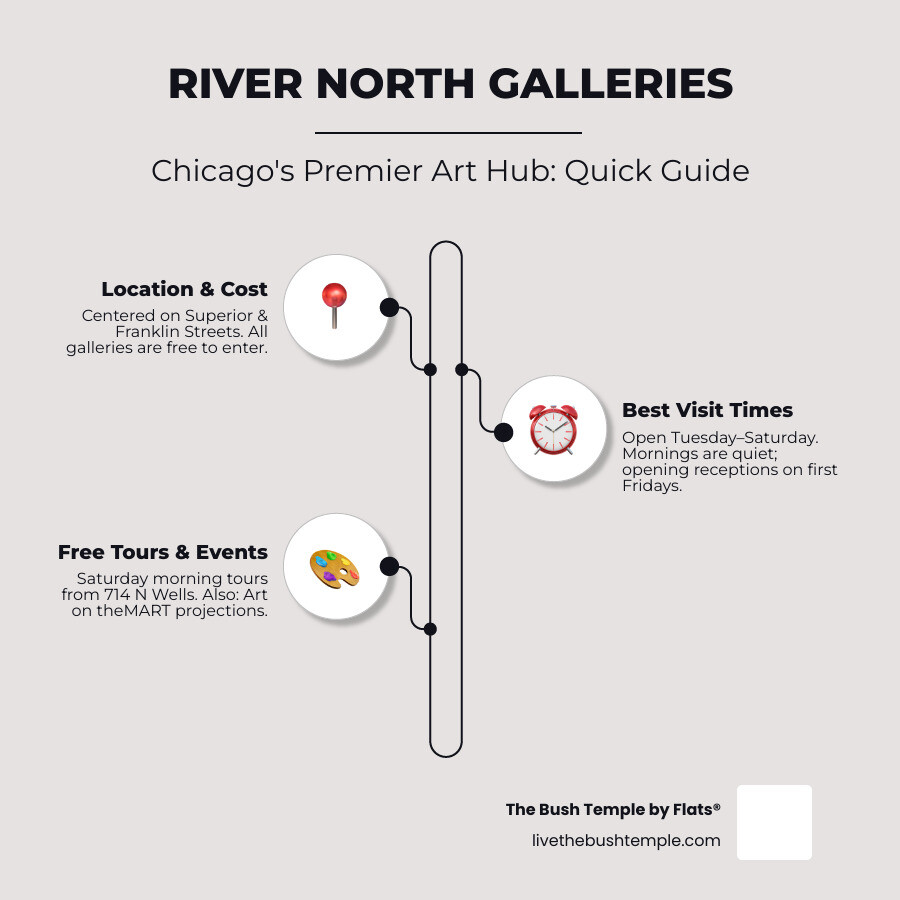
- Where: Centered on Superior Street and Franklin Street, bounded by Wells, Chicago, Orleans, and Huron Streets
- Cost: Free to enter — all galleries are commercial spaces funded by art sales, not ticket fees
- Best days: Tuesday through Saturday; most galleries are closed Sunday and Monday
- Best time: Tuesday or Wednesday mornings for a quiet, unhurried visit
- Free tours: Saturday morning tours hosted by Chicago Gallery News, departing from 714 North Wells Street
- Key event: Opening receptions on the first Friday of January, May, July, September, and November
- Public art: Art on theMART, the largest permanent digital art projection in the world, on the Merchandise Mart façade
The district grew in the 1970s when artists and dealers moved into abandoned factories and warehouses, converting raw industrial floors into exhibition spaces. Today, galleries here range from ancient encaustic painting techniques to monumental public sculpture and conservation photography.
One thing that surprises first-time visitors: many of these galleries are not at street level. They're tucked into upper floors of converted brick warehouse buildings, reached by freight elevators and wide industrial staircases. This layout contributes to the experience of exploring the district.
Whether visiting as an art collector, a weekend visitor, or a new resident, the following details assist in planning a visit.
History of the River North Galleries
The history of the river north galleries represents urban transformation and adaptive reuse. Before becoming a major cultural hub in the Midwest, the neighborhood was known by a very different name: "Smokey Hollow." During the late 19th and early 20th centuries, this pocket of Chicago was packed with heavy manufacturing plants, printing houses, and industrial warehouses. The air was constantly filled with a thick, dark smog emitted from the factories and coal-fired trains, making it one of the most heavily polluted industrial zones in the city.
By the mid-20th century, industrial activity declined, leaving behind a massive inventory of empty, soot-stained brick structures. For decades, these buildings sat vacant, and the area experienced high vacancy rates.
The turning point came in the 1970s. Pioneering real estate developer Albert Friedman stepped in, acquiring several empty buildings and working to rebrand the entire neighborhood. He coined the name "River North" to shed the negative associations of Smokey Hollow and attract creative tenants to the vacant industrial spaces.
At the same time, local artists and art dealers were searching for large, open spaces with high ceilings and abundant natural light. The historic loft buildings of River North met these requirements. These six- and eight-story brick structures offered expansive floor plans, heavy timber beams, and massive windows.

Throughout the 1970s and 1980s, a creative boom took hold. Dealers converted raw warehouse floors into sleek, whitewashed exhibition rooms. As more galleries moved in, the neighborhood rapidly transformed from a post-industrial wasteland into an arts destination. By the 1990s, the surrounding blocks developed into a bustling nightlife and dining hub, solidifying the area's status as a dining and entertainment district.
Today, the historic brick facades still show the architectural legacy of the city's manufacturing past, but the interiors host contemporary art. For a deeper look at the surrounding neighborhood's evolution, explore the River North District Chicago guide.
Essential Galleries to Visit in River North
The heart of the river north galleries district is walkable, with the densest clusters of art spaces located along West Superior Street, North Franklin Street, and North Wells Street. Because of this geographic concentration, visitors can easily explore a vast array of artistic genres in a single afternoon.
Exhibitions rotate every few weeks, meaning exhibitions change frequently. The district showcases everything from mid-century modernism and Chicago regionalism to fine art photography, abstract painting, and contemporary crafts.

Addington Gallery and Other Process-Driven River North Galleries
For those interested in texture, physical materials, and process-driven artwork, several galleries in the neighborhood are available to visit.
One established space is ADDINGTON GALLERY , located at 704 North Wells Street. Having operated in the district for 19 years, this gallery is known for its focus on process-oriented contemporary art. The gallery is open Tuesday through Saturday from 11:00 AM to 6:00 PM.
One specialty here is encaustic painting—an ancient, demanding technique dating back to the 4th century BC. This process involves using molten beeswax mixed with damar resin and raw pigments. Because the hot wax solidifies in approximately 10 seconds, the artist must work with speed and precision, using blowtorches to fuse each layer of wax onto wood panels or canvas. The result is a translucent, layered surface that allows viewers to see the layers of the piece's creation. The gallery also showcases works like oil paintings on oxidized copper and aluminum sheets.
Another stop for process-driven and physical mediums is ECHT GALLERY . This space frequently highlights contemporary crafts, including glass and ceramic sculptures. The gallery often collaborates with interior designers and participates in community events, showcasing how physical art mediums can integrate into residential spaces.
To experience art that merges visual expression with community narrative, visit Discover Evoke Gallery in Chicago, a vibrant hub empowering Artists. . This space focuses on nurturing emerging and mid-career creators. An example of their community-oriented programming is the "Cumbia Sin Fronteras" exhibition, which features over 45 local, national, and international artists celebrating the cultural impact of cumbia music through diverse visual mediums. The gallery also produces a companion zine, Promise(d) Magazine, to foster written dialogue alongside their physical exhibitions, and supports local organizations through limited-edition print collections.
Contemporary Photography and Sculpture at River North Galleries
If fine art photography, hyper-realistic sculpture, or contemporary design are of interest, the district offers several destinations.
At Hilton Contemporary | River North Art Gallery, Chicago , the focus is on contemporary photography and monumental fine art. The gallery represents internationally recognized photographers who use layered exposures, mixed-media collages, and conservation-focused imagery to explore themes of nature, memory, and the climate crisis.
The gallery's presence extends beyond its physical walls. For the summer and autumn of 2026, from June 1 to November 15, the gallery is presenting a public exhibition of monumental bronze and hyper-realistic swimmer sculptures by artist Carole Feuerman. These glossy sculptures are installed in public spaces along the Magnificent Mile and around the historic Wrigley Building, bridging the gap between indoor gallery curation and public streetscapes.
For contemporary paintings, street art, and design-forward installations, visit Art Gallery Chicago | Carousel Fine Art . Located at 230 West Superior Street, this gallery is open Tuesday through Saturday from 9:00 AM to 6:00 PM. The space frequently hosts solo exhibition openings for international street artists, interactive artist spotlights, and collaborative design events. They often partner with residential buildings and home staging firms to show how contemporary art can be integrated into living spaces.
Additionally, those interested in contemporary talent can look to 1010 GALLERY | 1010 N. Ashland Chicago . Established in 2025, this physical and digital platform serves as a resource for discovering emerging voices and curated collections that represent the evolving landscape of Chicago's art scene.
How to Navigate the River North Gallery District
Navigating the river north galleries differs from visiting a traditional museum. Because the district is housed within converted industrial warehouses, many galleries are located on the upper floors of multi-story buildings.
When arriving at a building address on Superior or Franklin Street, street-level storefronts are not present for every gallery. Instead, directories are located in the lobbies. Visitors utilize building intercoms, freight elevators, or staircases to reach the exhibition spaces.
Because these historic brick-and-timber buildings have thick walls, cell phone signals can be inconsistent once inside. Downloading or printing a gallery map from Chicago Gallery News before embarking on a tour is helpful.
Galleries in the district operate as commercial businesses. Staff are available to answer questions about the exhibitions. Asking about the current exhibition initiates a conversation.
Photography and Etiquette Tips:
- Ask Before Snapping: Always check with the front desk regarding photography policies, especially when viewing temporary or group exhibitions.
- Keep a Safe Distance: Many galleries feature open-floor configurations with sculptures or paintings displayed without barriers. Visitors should maintain distance from the artwork.
- Pet Policies Vary: Pet policies vary by location; some galleries, such as Addington Gallery, permit accompanied animals.
The following table compares self-guided walks and guided tours:
| Feature | Self-Guided Walk | Guided Tour (Chicago Gallery News) |
|---|---|---|
| Cost | Free | Free |
| Schedule | Fully flexible (Tuesday - Saturday) | Saturday mornings (11:00 AM - 12:30 PM) |
| Pace | Independent, quiet, self-paced | Structured, social, group-oriented |
| Access | Standard public exhibition viewing | Direct interaction with gallery directors |
| Best For | Collectors, quiet contemplation | First-time visitors, learning the history |
To map out a walking route, consult the Chicago River North Map to locate the primary gallery corridors.
What are the geographic boundaries of the River North gallery district?
The core of the gallery district occupies a ten-block stretch. The highest concentration of galleries is centered on West Superior Street and North Franklin Street. The general boundaries of this cultural pocket are defined by West Chicago Avenue to the north, North Wells Street to the east, West Huron Street to the south, and North Orleans Street to the west. The district also extends south toward the Chicago River and the Merchandise Mart building.
Are River North galleries free to visit?
Entering and exploring the galleries in River North is free of charge. Unlike traditional art museums, these are commercial exhibition spaces. Their revenue is generated through the sale of artwork to collectors, institutions, and designers, rather than through ticket sales. Visitors are welcome to browse the exhibitions and speak with staff during regular business hours.
When is the best time to visit the galleries?
The timing of a visit depends on the type of experience desired:
- For Solitude and Conversation: Tuesday or Wednesday mornings offer a quiet environment. These times allow visitors to view the art with fewer crowds.
- For a Lively, Social Atmosphere: Saturday afternoons see higher visitor activity.
- For New Art and Celebrations: Opening receptions typically take place on the first Friday of January, May, July, September, and November. These events feature refreshments and opportunities to meet the exhibiting artists.
Events, Tours, and Public Art Installations
Visits can be timed to coincide with public art events or organized tours.
For a structured introduction to the district, Chicago Gallery News hosts free gallery tours on Saturday mornings. These tours run rain or shine, typically departing at 11:00 AM from 714 North Wells Street. Led by guides, the tours stop at multiple galleries, offering participants an overview of current exhibitions.
Each summer, the neighborhood hosts the Mid Summer Art Walk. This public event is free to attend. Galleries host exhibit openings, while the surrounding streets feature entertainment, food vendors, and outdoor art installations.
Another event is the River North Design District Annual Gallery Walk. Held each autumn, this event pairs contemporary art galleries with design showrooms and interior designers. Artworks are displayed in room vignettes on Kinzie Street and the surrounding blocks, showing how art integrates with furniture and architecture.
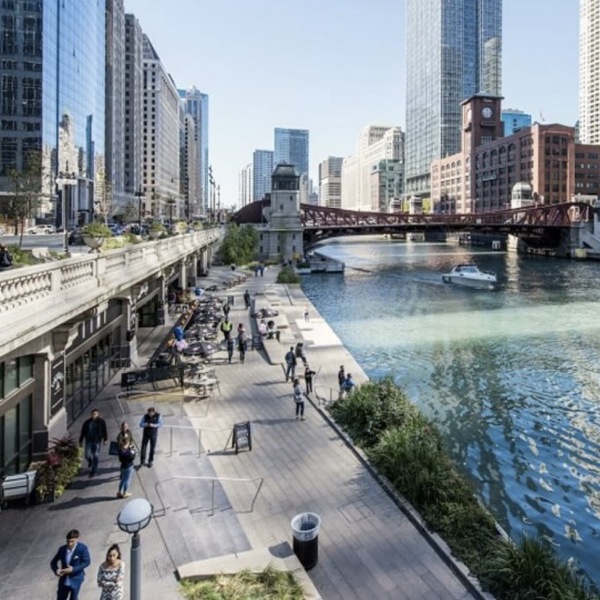
Art on theMART is also located in the area. Displayed on the 2.5-acre riverfront façade of the Merchandise Mart, this is a permanent digital art projection. Each evening, digital art projections light up the building, visible from the Chicago Riverwalk.
For additional activities in the area, consult the Chicago River North Things To Do guide.
Conclusion
The River North gallery district remains a key cultural area in Chicago. The neighborhood features a concentration of art spaces, history, and architecture.
For those seeking residential options near the gallery district, FLATS® offers apartments in the area. The Bush Temple combines historic architectural character with modern amenities, offering studio to two-bedroom apartments. Located on the border of River North and the Gold Coast, it features a fitness center, a rooftop lounge, and pet-friendly policies accommodating up to two pets.
To explore the local lifestyle, dining, and housing options in this neighborhood, consult the River North Neighborhood Chicago guide.